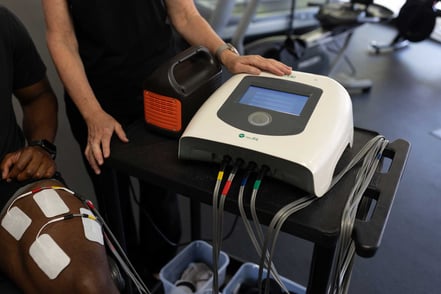
Interactive Metronome is a research-based therapeutic program that is quietly transforming the way practitioners think about brain health and rehabilitation and it may be more powerful than it sounds. At its core, it is a tool designed to help the brain and body work together more efficiently and it is gaining recognition across a wide range of clinical settings- including right here at EA Therapeutic Health, where it is part of our Functional Brain Health Program.
At the heart of what makes Interactive Metronome so compelling is something most of us rarely think about: timing. The brain's ability to coordinate timing underlies far more of our cognitive and motor functioning than we might expect, and when that system is supported, the results can be remarkable. Read on to discover exactly how Interactive Metronome works and why it might be exactly what your brain has been missing.
What Is Interactive Metronome?
Interactive Metronome, often referred to as IM, is a computer-based training program developed in the early 1990s that targets the brain's internal sense of timing and rhythm. It was built on the premise that the brain operates much like a conductor leading an orchestra- when the timing is precise and coordinated, everything flows. When it is off, the effects can show up in unexpected ways across many areas of daily life.
At its most basic level, IM is a tool that helps the brain and body get in sync. The ripple effects of that synchronization are what have made it a great option in brain health and rehabilitation settings around the world.
How Does It Work?
Interactive Metronome works by way of a process called auditory-motor timing calibration. This is a fancy way of describing the brain learning to align its internal clock with an external rhythm. During IM training, the brain is continuously challenged to anticipate, respond to, and refine its timing in relation to a steady, computer-generated beat. With each attempt, the brain receives immediate feedback on how close or far off its timing was, allowing it to make small but meaningful adjustments in real time. Over repeated sessions, this process gradually trains the brain to operate with greater precision and efficiency.
What makes this especially powerful is what happens between the brain and the body during that process. Brain-body synchronization- the ability of the brain to coordinate and sequence signals to the body smoothly and accurately- is at the center of so many skills we rely on daily. IM strengthens this communication pathway by requiring the brain and body to work together in a highly focused and coordinated way during every session. Think of it less like exercise for a single muscle and more like a full workout for the neural networks that keep the brain and body operating as one cohesive, well-timed system.
Who Does Interactive Metronome Help?
One of the things that makes Interactive Metronome such a versatile tool is the wide range of individuals it can benefit. It is perhaps most widely recognized as a support for children and adolescents, particularly those navigating challenges such as ADHD, dyslexia, and motor delays. For these individuals, difficulties with timing and neural synchronization often show up as struggles with attention, reading, writing, coordination, and the ability to sequence tasks- all areas where IM has shown meaningful promise.
IM is by no means limited to younger populations, however. Adults who find themselves struggling with cognitive timing- whether due to a neurological condition, a brain injury, the effects of aging, or simply a sense that their mental sharpness and physical coordination are not what they once were- have also found value in what IM has to offer. In short, if the brain's internal timing system could use some support, Interactive Metronome is worth considering regardless of age or background.
What Are the Benefits of Interactive Metronome?
For something rooted in something as simple as timing, the benefits of Interactive Metronome can be wide-ranging. While every individual's experience is unique, some of the most commonly reported benefits include:
- Enhanced focus and attention- By strengthening the brain's internal timing system, many individuals find it easier to sustain attention, stay on task, and filter out distractions in both academic and everyday settings.
- Better motor coordination- As the brain and body become more synchronized through IM training, movements tend to become smoother, more controlled, and better sequenced. This benefits everything from handwriting to athletic performance.
- Improved processing speed- With a more finely tuned neural clock, the brain is better equipped to take in, interpret, and respond to information quickly and accurately. This is a benefit that can show up in learning, communication, and reaction time.
What Does a Session Look Like?
One of the things people are often pleasantly surprised by when they experience Interactive Metronome for the first time is how engaging it is. Sessions are anything but passive. At EA Therapeutic Health, IM is incorporated into the Functional Brain Health Program as part of a personalized, individualized plan of care — meaning it is never applied in a one-size-fits-all way, but rather thoughtfully integrated based on each client's unique needs and goals.
During a typical session, the individual wears headphones and is guided to synchronize specific movements to a computer-generated beat. Hand and foot triggers are used to measure the accuracy of each response in real time, giving both the client and provider immediate insight into how the brain's timing system is performing and improving over time. The exercises themselves can vary widely depending on the individual- from simple hand clapping patterns to more complex movements that challenge coordination, balance, and cognitive engagement simultaneously.
Sessions generally range from about 30 to 60 minutes and are delivered over a series of weeks, giving the brain the repetition and gradual progression it needs to build lasting change. At EA Therapeutic Health, IM works alongside other innovative nervous system retraining tools within the Functional Brain Health Program, creating a comprehensive and coordinated approach to brain health that goes well beyond what any single tool could achieve on its own.
Conclusion
The brain is always capable of growth and change, and Interactive Metronome offers a unique and engaging way to support that process. Whether you are a parent looking for solutions for a child struggling with attention or learning, an adult navigating the effects of a brain injury or cognitive decline, or simply someone who feels like their brain and body could use better synchronization- IM may be worth exploring. And when it is delivered as part of a comprehensive, individualized program like the Functional Brain Health Program at EA Therapeutic Health, its potential is even greater.
If Interactive Metronome and/or our Functional Brain Health Program sounds like it could be a good fit for you or someone you love, we would love to hear from you. Reach out to the team at EA Therapeutic Health today to learn more. Also, check out the Interactive Metronome website for more information on it.